In this guide
- How to Spot a Fake Scholarship: A Step-by-Step Guide for Local and International Students
- 1. Understand What a Scholarship Scam Looks Like
- 2. Step One: Find Out Who Is Offering the Scholarship
- How to check the organisation
- 3. Step Two: Check the Website and Application Link
- Check the domain carefully
- What about the padlock symbol?
- A safer way to open an application
- 4. Step Three: Be Careful with Application, Processing and Release Fees
- Does every legitimate education opportunity have to be free?
- 5. Step Four: Recognise Fake Fully Funded Scholarship Promises
- Check what “fully funded” actually covers
- 6. Step Five: Confirm That the Scholarship Is Currently Open
- Watch out for recycled announcements
- 7. Step Six: Check Whether You Actually Applied
- 8. Step Seven: Verify the Email Address and Contact Person
- Warning signs
- 9. Step Eight: Protect Your Passport, Academic Records and Personal Information
- Before uploading any document
- 10. Step Nine: Investigate the Organisation Beyond Its Own Website
- 11. Step Ten: Check the Social Media Account Carefully
- 12. Step Eleven: Watch for Fake Scholarship Agents and Consultants
- 13. Step Twelve: Be Extra Careful with International Scholarships and Visa Offers
- Confirm the university
- Confirm the scholarship
- Confirm the visa information
- Confirm the admission process
- 14. Step Thirteen: Know Which Sources to Trust in Your Country
- 15. Step Fourteen: Use a Simple Scholarship Verification Checklist
- 16. Realistic Examples: Genuine Opportunity or Possible Scam?
- Example A: A scholarship message on WhatsApp
- Example B: A scholarship listed on a university website
- Example C: An agent promises guaranteed admission and funding
- Example D: A real scholarship with an admission application fee
- Example E: A scholarship announcement shared by a popular influencer
- 17. What to Do If You Think a Scholarship Is Fake
- 18. Frequently Asked Questions About Fake Scholarships
- Can a fully funded scholarship be genuine?
- Is every scholarship that asks for a fee fake?
- Can I trust a scholarship shared on WhatsApp?
- Is a scholarship fake if the website was created recently?
- Can a genuine scholarship provider ask for my passport?
- Can someone guarantee that I will win a scholarship?
- What if the scholarship is genuine but the deadline has passed?
- How can I tell whether a scholarship website is official?
- 19. Final Advice: Verify First, Apply Second
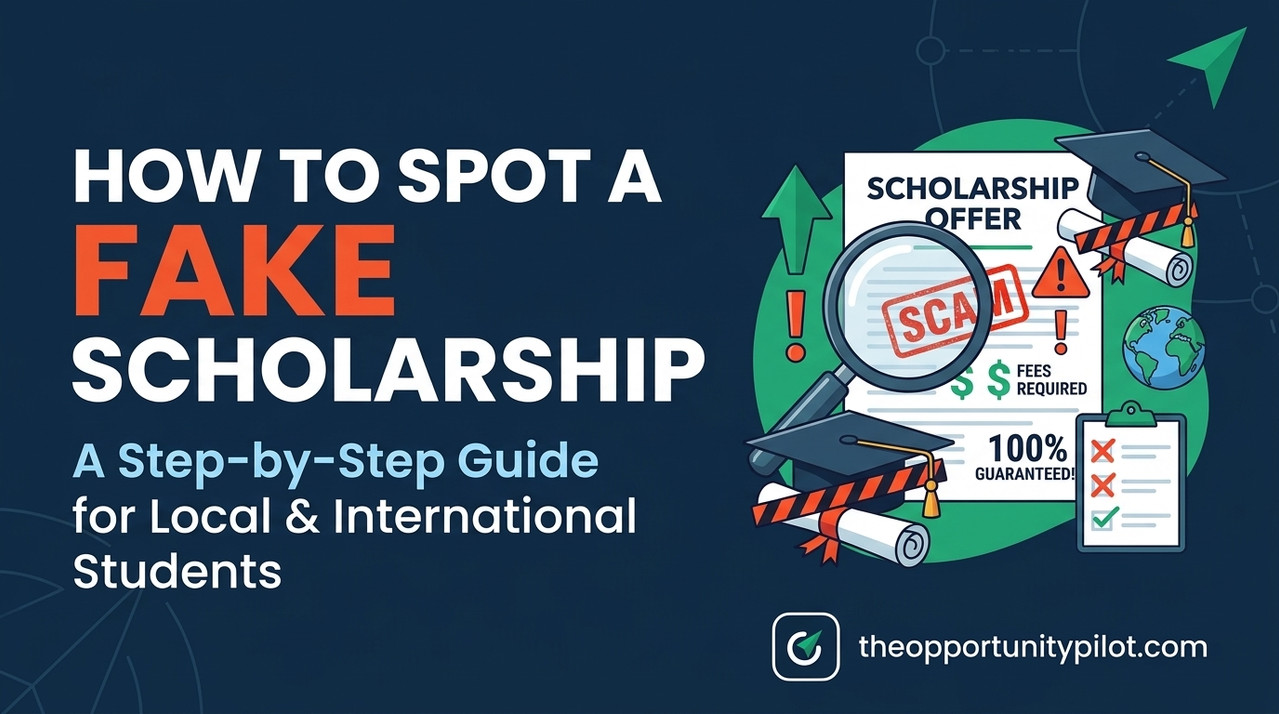
How to Spot a Fake Scholarship: A Step-by-Step Guide for Local and International Students
Last updated: October 2026
Every year, students search for scholarships to pay for tuition, accommodation, books, travel and other education expenses. Unfortunately, scammers also target students who need financial support. They create fake scholarship websites, copy real university announcements, impersonate government officials and send messages promising fully funded opportunities abroad.
Some scams are easy to spot. Others use genuine university logos, professional-looking websites, fake award letters and convincing social media accounts.
The good news is that you do not need to be a cybersecurity expert to protect yourself. You can learn how to check a scholarship, confirm the organisation behind it and identify warning signs before sharing your documents or money.
This guide from TheOpportunityPilot.com explains how to verify scholarship opportunities step by step, whether you are applying within your home country or planning to study abroad.
1. Understand What a Scholarship Scam Looks Like
A scholarship scam is an offer, message, website or service that misleads students to steal their money, personal information or account access.
Scammers may pretend to represent:
- Universities and colleges.
- Federal, state or local government agencies.
- Foreign governments and embassies.
- International scholarship programmes.
- Charities, foundations and non-governmental organisations.
- Private companies and corporate foundations.
- Famous philanthropists or wealthy individuals.
- Education consultants and scholarship agents.
Their goal is often to make you believe that an opportunity is genuine so that you will act before checking the facts.
For example, you might receive a WhatsApp message saying:
Congratulations! You have been selected for a fully funded scholarship in the United Kingdom. Pay ₦35,000 for registration today to secure your award. Only 20 students will be accepted.
This message contains several warning signs: an unexpected award, an upfront payment, pressure to act quickly and a promise of funding without a clear selection process.
Important: One warning sign does not always prove that an entire organisation is fraudulent. However, a suspicious payment request or an unverified award should be enough to stop you from proceeding until you have confirmed the facts independently.
2. Step One: Find Out Who Is Offering the Scholarship
Start by identifying the organisation responsible for the funding.
Ask yourself:
- What is the full name of the scholarship?
- Which university, government agency, foundation or company funds it?
- Who manages the application process?
- Which country and institution does it cover?
- Is the organisation officially connected to the scholarship?
Do not rely only on the name displayed in a WhatsApp message, Facebook post, email or online advert.
How to check the organisation
- Open a new browser tab.
- Search for the organisation's full name independently.
- Find its official website.
- Look for its scholarship, funding, financial aid or announcements section.
- Check whether the organisation itself mentions the scholarship.
- If you cannot find reliable confirmation, contact the organisation using details published on its independently located official website.
For example, if a message claims that a university is offering a fully funded master's scholarship, visit the university's official website and look for the programme there.
If the scholarship is administered by a foundation, check the foundation's website and look for evidence that it is responsible for the award.
Do not assume an organisation is genuine simply because it has a website, a logo, many followers or professional-looking documents. Fake organisations can create all of these things.
3. Step Two: Check the Website and Application Link
One of the most useful ways to identify a suspicious scholarship is to examine the website address carefully.
Scammers often create websites that resemble genuine universities, government agencies or scholarship programmes.
For example, a genuine institution might use a domain such as:
university-example.edu
A scammer might use a similar-looking address such as:
university-example-scholarship.com
These are fictional examples, not real university websites. The important lesson is that a familiar name inside a web address does not prove that the institution owns the website.
Check the domain carefully
Look for:
- Misspelled university or organisation names.
- Extra words such as “free-funding”, “official-award” or “2027-grant” that are not confirmed by the provider.
- Unusual domain endings or addresses that differ from the provider's known website.
- Application links hosted on unrelated websites.
- Websites that imitate the colours, logo or layout of a real institution.
- Forms that request sensitive information without explaining who collects it or why.
A different application domain is not automatically fraudulent. Some legitimate institutions use third-party application systems. The key question is whether the official scholarship provider links to that application system or confirms that it is authorised.
What about the padlock symbol?
A padlock or HTTPS connection means that the connection to a website is encrypted. It does not prove that the website is operated by a legitimate university, government or foundation.
A fraudulent website can also use HTTPS.
A safer way to open an application
Instead of clicking a link in a forwarded message:
- Search for the provider independently.
- Open its official website.
- Navigate to the scholarship announcement.
- Follow the application link provided there.
- Confirm that the application page matches the advertised scholarship and entry year.
If you cannot establish the connection between the provider and the application page, pause before submitting information.
4. Step Three: Be Careful with Application, Processing and Release Fees
Unexpected payment demands are among the strongest warning signs of scholarship fraud.
A scammer may ask for money under names such as:
- Scholarship registration fee.
- Award activation fee.
- Scholarship processing fee.
- Certificate verification fee.
- Funds release fee.
- Refundable security deposit.
- Scholarship reservation fee.
- Payment for a guaranteed selection.
- Courier charges for an award letter.
The scammer may claim that payment is required because the scholarship is fully funded, because you are among the final candidates or because the deadline is about to close.
Do not pay simply because the message sounds official.
The U.S. Federal Trade Commission warns students against scholarship offers that demand upfront payments to secure or release funding. https://consumer.ftc.gov/articles/how-avoid-scholarship-and-financial-aid-scams
Does every legitimate education opportunity have to be free?
Not necessarily. A university may charge an official admission application fee, examination fee or another clearly published charge. Some optional advisers or application-support companies may also charge for their services.
The important distinction is between a genuine, disclosed charge and a suspicious payment demand.
Before paying anything:
- Identify exactly what the payment covers.
- Check whether the charge is published on the institution's official website.
- Contact the institution using independently obtained contact details.
- Confirm who receives the money.
- Make sure the payment is made through an authorised channel.
An admission application fee is not the same as a scholarship fee. Paying an agent does not guarantee admission or funding.
Never pay an individual who claims they can guarantee your scholarship, bypass the selection process or release an award in exchange for money.
5. Step Four: Recognise Fake Fully Funded Scholarship Promises
The words “fully funded” attract many students because studying abroad can be expensive. Scammers know this and often use the phrase to make an offer appear irresistible.
A fraudulent advert might promise:
- Full tuition.
- Free accommodation.
- Monthly living allowances.
- International flight tickets.
- Visa sponsorship.
- Health insurance.
- A guaranteed admission letter.
- A guaranteed student visa.
- Immediate employment after graduation.
Some genuine scholarships provide several of these benefits. The problem is not the promise of funding itself; it is whether the promise matches the official scholarship terms.
Check what “fully funded” actually covers
Read the official funding information carefully.
| Funding item | What you should confirm |
|---|---|
| Tuition | Full tuition or only a partial contribution? |
| Living allowance | Is there a monthly stipend? How much and for how long? |
| Accommodation | Is housing provided, subsidised or excluded? |
| Travel | Are flights included, and under what conditions? |
| Health insurance | Is insurance provided or must you pay separately? |
| Visa expenses | Are visa-related costs covered, reimbursed or excluded? |
| Duration | Does funding cover the full course or only part of it? |
| Renewal | Must you maintain certain grades or meet other conditions? |
A genuine scholarship can have exclusions and conditions. An honest provider should explain them clearly.
If a third-party advert promises more benefits than the official scholarship page, trust the official terms until the provider confirms otherwise.
6. Step Five: Confirm That the Scholarship Is Currently Open
A real scholarship can still be advertised misleadingly.
For example, a scholarship may have existed in the past but no longer accept applications. A scammer may reuse an old announcement, change the deadline or claim that a new application round has opened.
Check the following details:
- Application opening date.
- Application deadline.
- Academic year or entry year.
- Eligible study level.
- Eligible courses or fields.
- Eligible nationalities and countries of residence.
- Whether applicants must first gain university admission.
- Whether the opportunity is open to new applicants or only existing students.
Watch out for recycled announcements
Suppose you find an announcement for a 2024 scholarship on social media in 2026. The original opportunity may have been genuine, but that does not mean applications are open again.
Do not assume that a scholarship runs every year simply because it did in previous years.
Look for a current announcement from the provider. If the deadline is unclear, contact the scholarship administrator.
For every opportunity you find on TheOpportunityPilot.com, check the published deadline and application status before proceeding.
7. Step Six: Check Whether You Actually Applied
One common scam begins with a message saying:
“You have been selected for an international scholarship.”
The message may claim that a university, embassy or government agency has chosen you to receive thousands of dollars, even though you never submitted an application.
An unexpected award notification is a major warning sign, especially if it asks you to pay money or provide bank details to receive the funds.
Legitimate scholarships can invite students to apply, nominate candidates or contact prospective applicants. However, you should be able to confirm the selection or invitation through the responsible organisation's official channels.
Ask yourself:
- Did I submit an application?
- Did I enter a competition or agree to be considered?
- Can I find the award on the provider's official website?
- Is there an identifiable selection process?
- Can the provider independently confirm the notification?
If you never applied, do not assume that you have won simply because the message contains your name.
8. Step Seven: Verify the Email Address and Contact Person
A message may display the name of a university, professor, embassy official or scholarship director. That does not mean the message genuinely came from that person.
Check the actual email address, not just the sender's display name.
Warning signs
- An email claiming to represent a university but sent from an unrelated personal account.
- A contact person who cannot be found through the institution's official channels.
- An email address with subtle spelling changes.
- A request to move the entire application process to a private messaging account.
- A refusal to provide an official programme page or verifiable contact details.
- A demand that you keep the award confidential.
A free email address does not automatically prove fraud, particularly for small charities or community organisations. Likewise, an email from a university-looking domain is not conclusive proof that the message is genuine.
If you receive a suspicious email, contact the institution through an email address or phone number found independently on its official website. Do not rely on the contact details provided in the suspicious message.
9. Step Eight: Protect Your Passport, Academic Records and Personal Information
Scholarship applications often require personal information. A genuine provider may eventually ask for transcripts, identification documents, proof of nationality, recommendation letters or financial information relevant to eligibility.
Scammers may collect the same information to commit identity fraud, impersonate applicants or target their accounts.
Be particularly careful if someone requests:
- Your email password.
- Your bank PIN or card security code.
- A one-time password (OTP).
- Your online banking login details.
- Your university account password.
- Unnecessary identity documents before you have verified the opportunity.
- Sensitive documents through an unverified form or personal messaging account.
Before uploading any document
- Verify the scholarship provider.
- Confirm that the application is open.
- Read the document requirements on the official application page.
- Check that the upload form belongs to the provider or an authorised application service.
- Share only the documents required at that stage.
- Avoid sending passwords, PINs or security codes to anyone.
A genuine scholarship provider may need proof of identity or bank details at an appropriate stage, particularly after selection. However, it should not need your password or one-time security code to award a scholarship.
Where appropriate, use a document watermark stating its intended purpose, such as “For [scholarship name] application only,” provided this is permitted and does not interfere with official verification requirements.
Do not alter official documents or hide information the provider legitimately requires.
10. Step Nine: Investigate the Organisation Beyond Its Own Website
A professional-looking website is only one piece of evidence. Try to find independent information about the organisation and the scholarship.
Search for:
- The organisation's full name alongside “scam”, “fraud” or “complaint”.
- News reports from reputable media outlets.
- Public announcements from the relevant government agency or university.
- Previous scholarship announcements and award results.
- Published eligibility requirements and selection procedures.
- Independent confirmation from an institution involved in the programme.
If an organisation claims to have awarded scholarships to thousands of students, check whether there is credible evidence of its activities.
Be cautious with testimonials. A collection of positive comments, photographs of award ceremonies or screenshots of payment notifications can be fabricated or taken from another organisation.
Also remember that a lack of negative search results does not prove that a scholarship is genuine. A newly created scam may not have been reported yet.
11. Step Ten: Check the Social Media Account Carefully
Fake scholarship offers spread through Facebook, Instagram, TikTok, Telegram, WhatsApp, LinkedIn and other platforms.
Scammers may copy the name and profile picture of a real organisation. Some create accounts that closely resemble genuine university or government accounts.
Before trusting a social media post:
- Visit the organisation's official website and look for its linked social media accounts.
- Check whether the account is mentioned by the organisation itself.
- Compare the post with the announcement on the official website.
- Examine the account's history and whether its content is consistent.
- Confirm that the application link is authorised by the provider.
- Be suspicious of accounts that rely mainly on payment requests and promises of guaranteed awards.
A verification badge can be helpful in some cases, but it is not enough on its own. Platform verification systems differ, and verified accounts can still be compromised.
Never treat a WhatsApp forward, viral video or large number of likes as proof that an opportunity is legitimate.
12. Step Eleven: Watch for Fake Scholarship Agents and Consultants
Some students use education consultants to help with university applications, document preparation or scholarship searches. Some providers charge for these services.
The risk arises when an agent claims to control a scholarship selection process or promises an outcome that they cannot guarantee.
Be cautious if an agent says:
- “I have a connection inside the embassy.”
- “Pay me and I will guarantee your scholarship.”
- “You do not need to meet the eligibility requirements.”
- “I can change your academic results.”
- “I can guarantee your student visa.”
- “Do not contact the university directly.”
- “Send your passport and payment before I reveal the scholarship name.”
Before using a consultant, ask for a written explanation of the service, the total cost, refund conditions and the organisation responsible for the scholarship.
Verify any claimed partnership directly with the university or funding body.
An agent may help you prepare an application, but payment to an agent does not guarantee a scholarship, university admission or visa approval.
13. Step Twelve: Be Extra Careful with International Scholarships and Visa Offers
International students may face additional risks because they are applying across borders and may not be familiar with another country's education system.
A fake opportunity might promise admission, a scholarship, employment and a visa through one payment.
Check each part separately.
Confirm the university
Look for the institution on the relevant country's official education or higher-education register. The appropriate register depends on the country and type of institution.
Confirm that the institution offers the course and study level advertised.
Confirm the scholarship
Find the scholarship on the university's or funder's official website. Read the eligibility requirements, funding terms and application instructions.
Confirm the visa information
Use the destination country's official immigration website or embassy website for visa requirements. A scholarship award does not automatically guarantee a visa.
Confirm the admission process
Check whether you must apply for university admission separately, whether the scholarship requires an offer of admission and whether a separate application deadline applies.
Be suspicious of anyone who promises a guaranteed visa or asks you to pay an unofficial person to secure a visa decision.
Visa rules, official fees and university requirements differ by country and can change. Always use current official information rather than relying only on a social media post or an agent's explanation.
14. Step Thirteen: Know Which Sources to Trust in Your Country
There is no single website that lists every genuine scholarship in the world. The best source depends on the scholarship provider and destination country.
Use the following sources as starting points.
For students in Nigeria
- Federal Ministry of Education — official education announcements and scholarship-related updates.
- Federal Ministry of Education: Scholarship Programme Clarification — an example of an official notice addressing false scholarship information.
- The official website of your state government, education ministry or scholarship board.
- Your university's official scholarship, student affairs or financial aid office.
For students applying to study in the United States
- U.S. Department of Education — federal education information.
- Federal Trade Commission scholarship scam guidance — warning signs and practical advice.
- EducationUSA — information and guidance for international students considering study in the United States.
For students applying to study in the United Kingdom
- GOV.UK — official government and immigration information.
- British Council — education and international study information.
- The university's official website and international student office.
For students applying elsewhere
Start with the destination country's government education department, official immigration service, relevant embassy or high commission, and the university or funding organisation itself.
For government funding in particular, be cautious of unsolicited messages promising free money. For example, the U.S. government's Grants.gov guidance on grant-related scams explains why unexpected grant offers and requests for fees are warning signs. Government grant rules differ between countries, so use the relevant country's official guidance.
15. Step Fourteen: Use a Simple Scholarship Verification Checklist
Before applying for any scholarship, go through this checklist. If you cannot confirm an important detail, pause and investigate further.
- I know the full name of the scholarship.
- I have identified the organisation responsible for the award.
- I have found the opportunity on the provider's official website or received independent confirmation.
- I have checked that the application cycle is current.
- I have confirmed the deadline.
- I have read the eligibility requirements.
- I understand what the funding covers and what it excludes.
- I have traced the application link back to the official provider.
- I have checked any application or admission fee independently.
- I have not been promised a guaranteed scholarship or visa in exchange for money.
- I know why each requested document is needed.
- I am using a verified contact channel.
- I have checked the official visa and admission requirements if I am applying internationally.
Your decision: If the provider, award or application route cannot be verified, label the opportunity unverified and do not send money or sensitive documents until you have resolved the questions.
16. Realistic Examples: Genuine Opportunity or Possible Scam?
The examples below are fictional and are designed to help you practise.
Example A: A scholarship message on WhatsApp
Message: “You have been selected for a fully funded scholarship in Canada. Send ₦50,000 to our coordinator to release your award letter.”
Assessment: High risk.
Why? The message claims you have been selected, demands money to release an award and directs you to an individual rather than a clearly verified official process.
What to do: Do not pay. Search for the scholarship independently and contact the claimed provider using its official contact details.
Example B: A scholarship listed on a university website
Message: A university publishes a scholarship announcement on its official website, explains eligibility, provides an application deadline and links to an application portal.
Assessment: More credible, but still check the details.
What to do: Confirm that the university owns the website, the scholarship is open for the relevant year and the application portal is linked or confirmed by the university. Read the conditions before applying.
Example C: An agent promises guaranteed admission and funding
Message: “Pay my service fee today. I will guarantee your admission, full scholarship and visa.”
Assessment: High risk.
Why? The agent is promising several outcomes that depend on separate decisions by universities, scholarship providers and immigration authorities.
What to do: Ask for written service terms, verify any claimed partnership and contact the institutions independently. Do not pay for a guaranteed result.
Example D: A real scholarship with an admission application fee
Message: A university charges an officially published admission application fee. Eligible applicants may separately apply for a scholarship.
Assessment: Not automatically a scam.
What to do: Verify the fee through the university's official admissions website. Check whether the scholarship application itself is free or has separate published terms. Never pay an unrelated individual who claims to control the scholarship.
Example E: A scholarship announcement shared by a popular influencer
Message: An influencer with thousands of followers shares a link to a new international scholarship.
Assessment: Unverified until checked.
Why? Popularity does not establish that the funder has authorised the post.
What to do: Find the scholarship on the funder's official website and follow the application route published there.
17. What to Do If You Think a Scholarship Is Fake
If you discover a suspicious offer, stop communicating with the sender until you can verify the claim. Do not pay more money to recover an earlier payment or secure a supposed award.
If you have already paid or shared information, act quickly.
If you sent money:
- Contact your bank or payment provider through its official channel.
- Explain what happened and provide the transaction reference.
- Ask whether the payment can be stopped, disputed or recovered.
- Save receipts, messages, account details and screenshots.
- Report the incident to the relevant authorities in your country.
Recovery is not guaranteed, but acting quickly may help.
If you shared a password or security code:
- Change the affected password immediately using the genuine website.
- Change the same password on other accounts if you reused it.
- Enable multi-factor authentication where available.
- Contact the relevant bank, university or service provider if the account may have been compromised.
- Never share additional one-time codes with someone claiming to help.
If you uploaded identity documents:
Keep a record of what you shared and when. Contact the relevant institution or authorities for advice on reducing the risk of identity misuse. Monitor relevant accounts and respond promptly to suspicious activity.
If you found a fake announcement:
Report the post or account to the platform hosting it. Notify the real university, foundation or government agency whose name has been used. If appropriate, warn other students without publishing other people's private information.
18. Frequently Asked Questions About Fake Scholarships
Can a fully funded scholarship be genuine?
Yes. Some legitimate scholarships cover tuition, living costs, travel, insurance or other expenses. Verify the funder, official announcement, eligibility requirements and funding terms before applying.
Is every scholarship that asks for a fee fake?
Not necessarily. Separate scholarship fees from official university admission fees, examination charges or optional paid services. Check any fee independently through the responsible institution. A payment to guarantee selection or release an award is a serious warning sign.
Can I trust a scholarship shared on WhatsApp?
You can use WhatsApp to discover opportunities, but do not treat a forwarded message as proof. Confirm the scholarship through the official provider before applying or sharing documents.
Is a scholarship fake if the website was created recently?
Not automatically. New organisations and new programmes can be legitimate. However, a new or unfamiliar website requires careful checking, particularly if it asks for money or sensitive information.
Can a genuine scholarship provider ask for my passport?
Yes, a provider may need identity or travel documents at an appropriate stage. First verify the programme and the application route, then check that the document is required. Never share account passwords, banking PINs or one-time security codes.
Can someone guarantee that I will win a scholarship?
Be extremely cautious of anyone promising guaranteed selection in exchange for money. A consultant can help with preparation, but the scholarship provider controls its own eligibility and selection process.
What if the scholarship is genuine but the deadline has passed?
Do not apply through an old link unless the provider confirms that applications remain open. Look for the next official application cycle or other opportunities with current deadlines.
How can I tell whether a scholarship website is official?
Start from the organisation's independently located website and follow its scholarship announcement to the application page. Check the domain, contact details and programme information. HTTPS, logos and professional design alone are not enough.
19. Final Advice: Verify First, Apply Second
Finding a scholarship can take time, and it is understandable to feel excited when an opportunity promises to cover your education expenses. But excitement should never replace verification.
Before applying, know who is offering the scholarship, where the official announcement appears, what the funding covers, whether the application is open and how the provider expects you to apply.
If something does not add up, pause and ask questions. A genuine opportunity should be supported by information you can check independently.
At TheOpportunityPilot.com, our goal is to help students discover opportunities, prepare stronger applications and make informed decisions. Use this guide whenever you find a scholarship, grant, fellowship, internship or international study opportunity you are unsure about.
Save this checklist, share it with another student and verify every opportunity before you send money or personal documents.