In this guide
- Introduction: Do Not Submit Your Scholarship Application Until You Check These Things
- 1. Confirm That You Are Eligible
- Your eligibility check
- 2. Confirm the Deadline, Time Zone, and Submission Method
- Your action
- 3. Check Every Required Document
- Academic documents
- Identification documents
- Personal and supporting documents
- Your document audit
- 4. Review Your CV or Resume
- Do not make your CV longer just to impress the committee
- 5. Review Your Personal Statement or Motivation Letter
- Does my statement answer the actual question?
- Have I explained my motivation clearly?
- Have I provided evidence?
- Have I explained my future plans realistically?
- Personal statement checklist
- 6. Check Your Recommendation Letters
- What if a referee has not submitted a letter?
- 7. Confirm Your Course and University Details
- 8. Check Language Tests and Other Qualifications
- 9. Verify Your Application Form
- 10. Check File Names, Formats, and Uploads
- 11. Review Scholarship-Specific Essays and Questions
- 12. Understand What the Scholarship Covers
- 13. Watch Out for Scholarship Scams
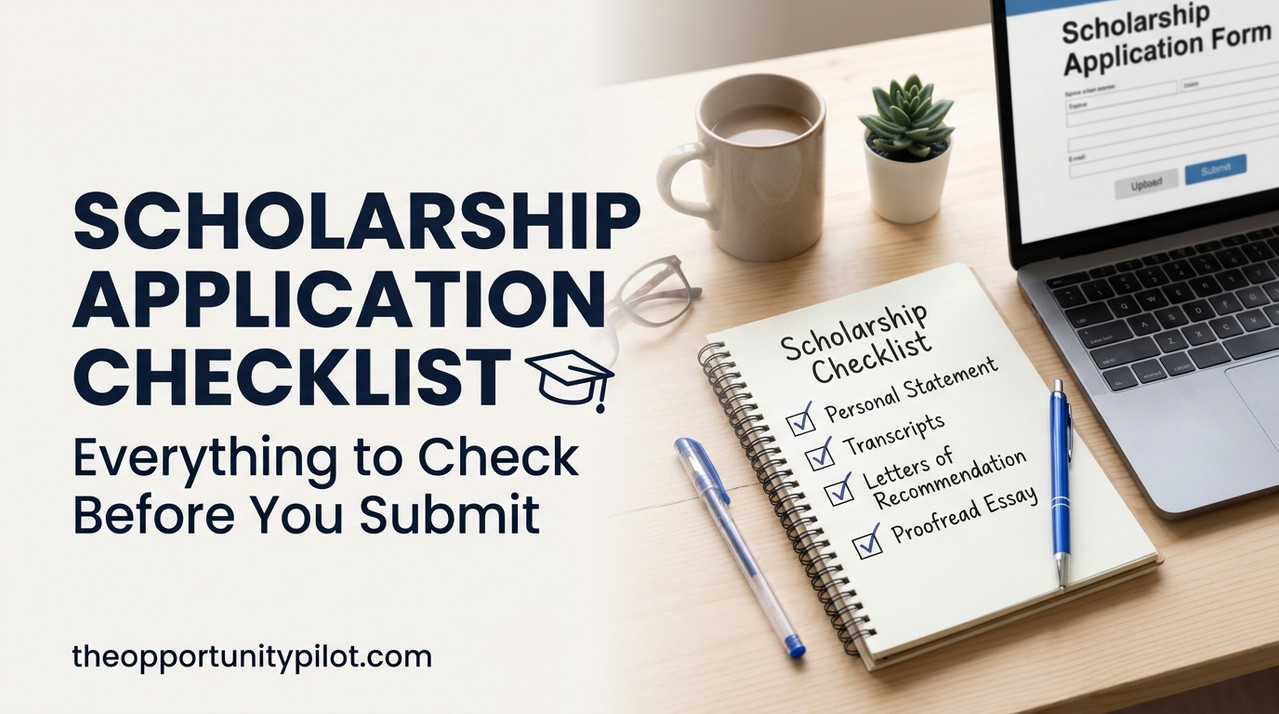
- 14. Your Final Scholarship Submission Checklist
- Eligibility and deadline
- Documents
- Application form
- Final submission
- 15. What to Do After Submitting Your Application
- Conclusion: Give Your Application One Final Review
Introduction: Do Not Submit Your Scholarship Application Until You Check These Things
Finding a scholarship can take weeks or even months. You may spend hours researching universities, writing your personal statement, requesting recommendation letters, and gathering academic documents.
But after all that work, a small mistake can weaken your application.
You might upload the wrong transcript, overlook an eligibility requirement, forget a compulsory essay, submit an incomplete application form, or miss the deadline because you misunderstood the time zone.
The good news is that many of these mistakes can be prevented with a careful final review.
This guide provides a practical scholarship application checklist you can use before submitting an application to a university, government scholarship programme, foundation, international organisation, or other scholarship provider.
You do not have to wait until you finish reading. Open the scholarship application you are preparing and follow each section as you go.
Your goal is simple: submit a complete, accurate, relevant, and well-prepared application that follows the scholarship provider's instructions.
1. Confirm That You Are Eligible
Before reviewing your documents, return to the official scholarship announcement and confirm that you meet the eligibility requirements.
Do not rely only on a social media post, a scholarship blog, or an agent's explanation. Open the official scholarship website and read the requirements yourself.
Check the following:
- Nationality: Does the scholarship accept applicants from your country?
- Academic level: Is it for undergraduate, master's, PhD, or another type of study?
- Academic qualifications: Do you have the required degree, grades, or equivalent qualification?
- Graduation status: Must you already have graduated, or can final-year students apply?
- Age limit: Does the scholarship have an age requirement?
- Course or subject: Is your intended course eligible?
- University or institution: Must you apply to an approved university or programme?
- Language requirements: Is an English or other language test required?
- Work experience: Is professional experience compulsory?
- Previous funding: Are applicants who already hold another scholarship eligible?
- Other conditions: Are there additional rules about residency, previous study, or financial circumstances?
Requirements differ between scholarship programmes. Never assume that qualifying for one scholarship means you automatically qualify for another.
Your eligibility check
Complete this table before proceeding.
| Requirement | My status |
|---|---|
| My nationality is eligible | Yes / No / Unclear |
| I meet the academic requirements | Yes / No / Unclear |
| My course or study level is eligible | Yes / No / Unclear |
| I meet any age or graduation requirements | Yes / No / Unclear |
| I meet the language requirements | Yes / No / Unclear |
| I meet other programme conditions | Yes / No / Unclear |
If you answer No to a mandatory requirement, contact the scholarship provider if the rule is unclear. Otherwise, focus on scholarships for which you qualify.
If you answer Unclear, resolve the question before investing more time in the application.
2. Confirm the Deadline, Time Zone, and Submission Method
A strong application submitted after the deadline may not be considered.
Do not record only the date. Check the exact closing time and time zone, if provided.
For example, a deadline of 11:59 p.m. in the scholarship provider's local time may fall on a different calendar date in Nigeria.
Check:
- The official application deadline.
- The exact closing time.
- The time zone used by the provider.
- Whether the deadline is for the scholarship application, university admission, or both.
- Whether your university application must be completed first.
- Whether recommendation letters must arrive before the same deadline.
- Whether documents must be uploaded before final submission.
- Whether the provider accepts late applications.
Some scholarship programmes require applicants to complete two separate processes: university admission and scholarship funding. Completing one does not necessarily complete the other.
Your action
Write down your deadline and set a reminder several days before it.
My scholarship deadline: __________________________
Closing time and time zone: __________________________
My personal submission target: __________________________
Aim to finish early enough to deal with technical problems, missing documents, or delays from referees.
3. Check Every Required Document
One of the most important parts of a scholarship application is making sure that every required document is ready.
The exact list depends on the programme. Use the official checklist as your main reference.
Commonly requested documents include the following.
Academic documents
- Academic transcript.
- Degree certificate or other proof of qualification.
- Secondary school results, if required.
- Proof of expected graduation, if you are still studying.
- Grading scale or explanation of grades, if requested.
- Certified translations, if your documents are not in an accepted language.
Check whether the scholarship provider requires official transcripts, certified copies, or documents sent directly by your institution.
Do not assume that a screenshot of your results or an unofficial transcript will be accepted.
If you have not received your degree certificate, check whether a provisional certificate, completion letter, or official transcript is permitted.
Identification documents
- Valid passport, if required.
- National identity document, if requested.
- Proof of residency or nationality, if required.
Check that your name and other identifying details match across your documents. If your name differs between documents, follow the provider's instructions for explaining or correcting the difference.
Do not upload sensitive identity documents to unofficial websites or send them to unverified individuals.
Personal and supporting documents
- Curriculum vitae (CV) or resume.
- Personal statement or motivation letter.
- Scholarship-specific essays.
- Recommendation letters.
- Research proposal, if required.
- Portfolio or writing sample, if requested.
- Language test results, if required.
- Proof of work experience, if requested.
- Financial or family information, if required by the scholarship.
Not every scholarship requires all these documents. Some programmes have additional requirements, so do not use a generic list as a replacement for the official instructions.
Your document audit
Open your application and compare its document requirements with the files on your computer.
For every required document, confirm three things:
- The document exists.
- It is the correct and current version.
- It meets the provider's format and upload requirements.
If a document is missing, identify exactly how you will obtain it and how long that may take.
4. Review Your CV or Resume
Your CV should help the scholarship selection committee understand your academic background, achievements, experience, skills, and potential.
It should be accurate, easy to read, and relevant to the scholarship.
Check the following before submitting:
- My name and contact details are correct.
- My educational qualifications and dates are accurate.
- My grades and awards are presented truthfully.
- My work experience is relevant and clearly described.
- My volunteering, leadership, research, or community involvement is included where useful.
- My skills are supported by genuine experience or evidence.
- My professional courses and certifications are accurate.
- My CV follows any page limit or format specified by the provider.
- I have checked spelling, grammar, and formatting.
- I have used the required file format.
Do not make your CV longer just to impress the committee
Include information that helps demonstrate your suitability for the scholarship. You do not need to list every activity you have ever done.
For a research scholarship, relevant research experience, academic projects, publications, and technical skills may be important.
For a leadership scholarship, evidence of initiative, responsibility, community involvement, and measurable contributions may be more relevant.
For a scholarship focused on development or social impact, experience addressing a community or professional problem may strengthen your application.
Follow the programme's criteria rather than trying to make every CV look the same.
5. Review Your Personal Statement or Motivation Letter
Your personal statement is often one of the most important parts of a scholarship application because it helps the selection committee understand your motivation and goals.
A good statement does more than explain that you need financial assistance. It connects your background, experience, academic interests, future plans, and the purpose of the scholarship.
Before submitting, ask yourself the following questions.
Does my statement answer the actual question?
Read the essay prompt again. If the provider asks about leadership, do not write an essay focused mainly on financial need.
If the question asks why you selected a particular course, explain the connection between that course and your goals.
If the provider asks how you intend to contribute to your community, describe the problem you want to address and how your education may help.
Have I explained my motivation clearly?
Your statement should help the committee understand:
- Why you want to pursue this course or programme.
- What experiences influenced your decision.
- What you hope to learn.
- How the scholarship supports your plans.
- What you intend to do with the opportunity.
Be specific. General statements such as "I want to change the world" are less informative than a clear explanation of the problem you want to solve and the work you hope to do.
Have I provided evidence?
If you describe yourself as a leader, explain what you led and what you learned.
If you say you are passionate about research, discuss a project, question, or experience that demonstrates that interest.
If you describe a challenge, explain how you responded and what the experience taught you.
Your examples should be truthful and relevant.
Have I explained my future plans realistically?
You do not need to predict every detail of your future. However, your goals should make sense in relation to the course and scholarship.
Explain what you hope to do after your studies, which skills or knowledge you need, and how you intend to apply them.
If the scholarship has specific development, leadership, or community objectives, show how your plans connect to them.
Personal statement checklist
- I answered every part of the essay question.
- I explained why this course or programme matters to me.
- I provided specific examples from my experience.
- I connected my background to my future goals.
- I explained why the scholarship is relevant to my plans.
- I followed the word or character limit.
- My statement sounds natural and reflects my real experiences.
- I removed repeated points and unnecessary information.
- I checked spelling, grammar, and punctuation.
- I followed any rules about AI assistance, originality, or disclosure.
Important: Use editing tools or AI assistance only in ways permitted by the scholarship provider. Do not invent experiences, achievements, hardships, or qualifications. You must be able to explain and defend every claim in your statement.
6. Check Your Recommendation Letters
Some scholarships require one or more recommendation letters from lecturers, academic supervisors, employers, or other approved referees.
A strong recommendation should provide credible evidence of your abilities and suitability for the opportunity.
Before submitting, confirm:
- I have the required number of referees.
- Each referee meets the programme's rules.
- I have requested the letters early enough.
- My referees know the scholarship deadline.
- They have my updated CV and relevant application information.
- They understand the course or scholarship I am applying for.
- The letters have been submitted through the correct method.
- The portal shows the required recommendation as received, if a status is provided.
Some programmes ask referees to upload letters directly. Others allow the applicant to upload a signed letter. Follow the exact instructions.
Do not assume that entering a referee's email address completes the recommendation requirement. The referee may still need to submit a form or letter.
What if a referee has not submitted a letter?
Send a polite reminder with the deadline and the relevant instructions. If the portal permits it, check whether the provider allows you to resend the invitation or nominate another referee.
Do not write a recommendation letter and present it as though your referee independently prepared it unless the process explicitly permits a draft for the referee's review and approval.
7. Confirm Your Course and University Details
A scholarship application may ask you to name your intended course, university, department, or study destination.
These details must be consistent across your application.
Check:
- I have selected the correct university.
- I have entered the correct course title.
- My intended study level is correct.
- The course is eligible for this scholarship.
- The course start date or intake is correct.
- I have checked whether university admission is a separate process.
- I understand whether an admission offer is required before applying for funding.
- My personal statement matches the course I selected.
This is especially important for scholarships that fund only certain universities, departments, subjects, or programmes.
If you are applying to multiple universities, review each application separately. Do not accidentally leave one university's name in a statement intended for another institution.
8. Check Language Tests and Other Qualifications
Some scholarships or universities require proof of English or another language proficiency.
Depending on the programme, accepted evidence may include a recognised test result, previous education in an approved language of instruction, or an official exemption.
Check:
- Whether a language test is compulsory.
- Which tests the institution accepts.
- The minimum overall score.
- Any minimum score required for individual sections.
- Whether the result is still valid.
- Whether an exemption is available and applies to me.
- Whether the scholarship and university have separate language requirements.
Do not assume that a language-test waiver for university admission automatically applies to the scholarship itself.
If you have not taken a required test, check the official rules and available test dates. Do not claim that you meet a requirement until you have confirmed it.
9. Verify Your Application Form
Once your documents are ready, review the online form carefully.
Small inconsistencies can create confusion or delay the review process.
Check these fields:
- Full name and date of birth.
- Email address and phone number.
- Nationality and residency details.
- Educational institutions and dates attended.
- Qualifications and grades.
- Work and volunteering experience.
- Course and university choices.
- Referee names and email addresses.
- Responses to eligibility questions.
- Scholarship-specific questions.
- Any declarations or consent statements.
Compare your form with your CV, transcript, passport, and other supporting documents.
If the form asks for exact dates, use the correct information rather than estimating. If a field does not apply to you, follow the portal's instructions for leaving it blank or selecting the appropriate option.
Answer questions about financial circumstances, previous scholarships, disciplinary matters, or other sensitive topics honestly.
10. Check File Names, Formats, and Uploads
Even when you have the correct documents, uploading them incorrectly can create problems.
Some portals accept PDF files only. Others specify maximum file sizes, page limits, image dimensions, or naming conventions.
Before submitting:
- I have used the requested file format.
- Every document opens correctly.
- Scanned documents are readable.
- All pages are included and correctly oriented.
- No text is cut off.
- The file size is within the permitted limit.
- My filenames are clear and professional.
- I have uploaded the correct version of each document.
- Each file appears in the correct field.
- I have checked that the upload has finished.
For example, clear filenames might be:
- FullName_CV.pdf
- FullName_Transcript.pdf
- FullName_Personal_Statement.pdf
- FullName_Degree_Certificate.pdf
Use the scholarship provider's requested naming format if one is specified.
If the portal displays a preview, open it and inspect the uploaded document. Do not rely only on the fact that a filename appears on the screen.
11. Review Scholarship-Specific Essays and Questions
Some scholarship applications include additional questions that are separate from the main personal statement.
These may ask about leadership, community involvement, financial need, research interests, professional plans, or how you will contribute to a particular field.
Treat every question as an independent requirement.
For each response, check:
- I answered the question directly.
- I addressed every part of the prompt.
- I provided specific examples where appropriate.
- I followed the word or character limit.
- I avoided repeating my personal statement unnecessarily.
- I connected my answer to the scholarship's stated criteria.
- My response is accurate and truthful.
- I followed any originality or AI-use rules.
If a question asks for leadership experience and you have not held a formal leadership title, consider whether you have examples of taking responsibility, organising a project, supporting a team, or helping solve a problem. Do not invent a title or exaggerate your role.
12. Understand What the Scholarship Covers
Before accepting a scholarship or committing to a university, understand its financial terms.
The word "scholarship" does not always mean that every expense will be covered.
Depending on the programme, funding may cover some or all of the following:
- Tuition fees.
- A monthly living allowance.
- Accommodation.
- Travel.
- Health insurance.
- Research expenses.
- Books or study materials.
- Visa-related costs.
Some awards cover only tuition fees. Others provide a stipend, while the recipient must pay for travel, accommodation deposits, insurance, or other expenses.
Check the official funding terms and ask the provider about any unclear costs.
Also check whether the scholarship is renewable, whether you must maintain a certain academic performance, and whether there are conditions attached to receiving or keeping the award.
Do not assume that a scholarship will cover your visa or relocation costs unless the official terms say so.
13. Watch Out for Scholarship Scams
Before submitting personal information or paying any fee, make sure the opportunity is genuine.
Be cautious if someone:
- Guarantees you a scholarship in exchange for money.
- Claims they can influence the selection committee.
- Requests payment to release a scholarship award.
- Uses a suspicious email address or unofficial website.
- Pressures you to pay quickly.
- Requests passwords, banking credentials, or unnecessary sensitive information.
- Sends an award letter that cannot be verified through the official institution.
Some legitimate application processes involve fees, but you must verify them independently. If a fee is required, confirm the amount, purpose, and payment method on the official website.
To protect yourself:
- Visit the official scholarship website directly.
- Confirm that the programme and application portal are genuine.
- Verify the deadline and requirements.
- Use published contact information to resolve doubts.
- Avoid sending money or sensitive documents to unverified individuals.
If an offer seems too good to be true, investigate it before taking action.
14. Your Final Scholarship Submission Checklist
Use this checklist immediately before clicking the final submit button.
Eligibility and deadline
- I meet the eligibility requirements.
- My course and university are eligible.
- I have confirmed the deadline and time zone.
- I have checked whether a separate admission application is required.
Documents
- My CV is complete and accurate.
- My transcript and certificates are correct.
- My personal statement is final.
- All required essays are complete.
- My recommendation letters are submitted or arranged according to the instructions.
- My language results and other certificates are included where required.
- All files meet the requested format and size limits.
Application form
- My personal details are correct.
- My education and experience details match my documents.
- My course and university details are correct.
- Every mandatory question is answered.
- I have checked my spelling and grammar.
- I have reviewed all declarations before agreeing to them.
Final submission
- I have reviewed the entire application.
- I have checked each uploaded document.
- I understand what the scholarship covers.
- I have confirmed that I am using the official application portal.
- I am ready to submit.
- I will save the confirmation and application reference after submitting.
If any compulsory item remains incomplete, address it before submitting unless the official instructions specifically permit you to provide it later.
15. What to Do After Submitting Your Application
Submitting the form is an important milestone, but it is not necessarily the end of the process.
After submission:
- Save your confirmation. Download the confirmation page or keep the confirmation email.
- Record your application reference. Store it somewhere safe.
- Update your tracker. Record the submission date and current status.
- Monitor your email. Check your inbox and spam folder for messages from the official provider.
- Watch the application portal. Some providers publish updates or request additional documents there.
- Prepare for interviews. If the scholarship includes interviews or assessments, begin preparing.
- Respond before any new deadline. If additional documents are requested, follow the instructions carefully.
- Continue searching. Do not stop considering other suitable scholarships while you wait.
If you discover a mistake after submission, contact the scholarship provider through its official channel. Explain the problem clearly and ask whether corrections are possible. Do not assume that every application can be edited after submission.
Conclusion: Give Your Application One Final Review
A scholarship application is more than a collection of documents. It is an opportunity to show that you meet the programme's requirements, have clear goals, and are prepared to make good use of the funding.
Before you submit, take a little extra time to verify your eligibility, review your personal statement, confirm your supporting documents, check your application form, and understand the scholarship's conditions.
You cannot control every part of a scholarship selection process, but you can control how carefully you prepare and submit your application.
Your next step: Open your scholarship application now and work through the final checklist. If you have not found a suitable scholarship yet, start with official scholarship websites and confirm the requirements before preparing your documents.
For more scholarship opportunities, application guides, and career resources, visit TheOpportunityPilot.com.
OpportunityPilot — Less searching. More direction.
Important note: Scholarship requirements vary by provider and may change between application cycles. The official scholarship announcement and application portal should always take priority over a general checklist.