
Sir Patrick Stewart, the acclaimed British actor known worldwide for playing Captain Jean-Luc Picard in Star Trek and Professor Charles Xavier in X-Men, has died aged 86. He died at his Los Angeles home on 28 October 2026 after living with Alzheimer's disease and Lewy body dementia, according to a family statement shared on his social media accounts.
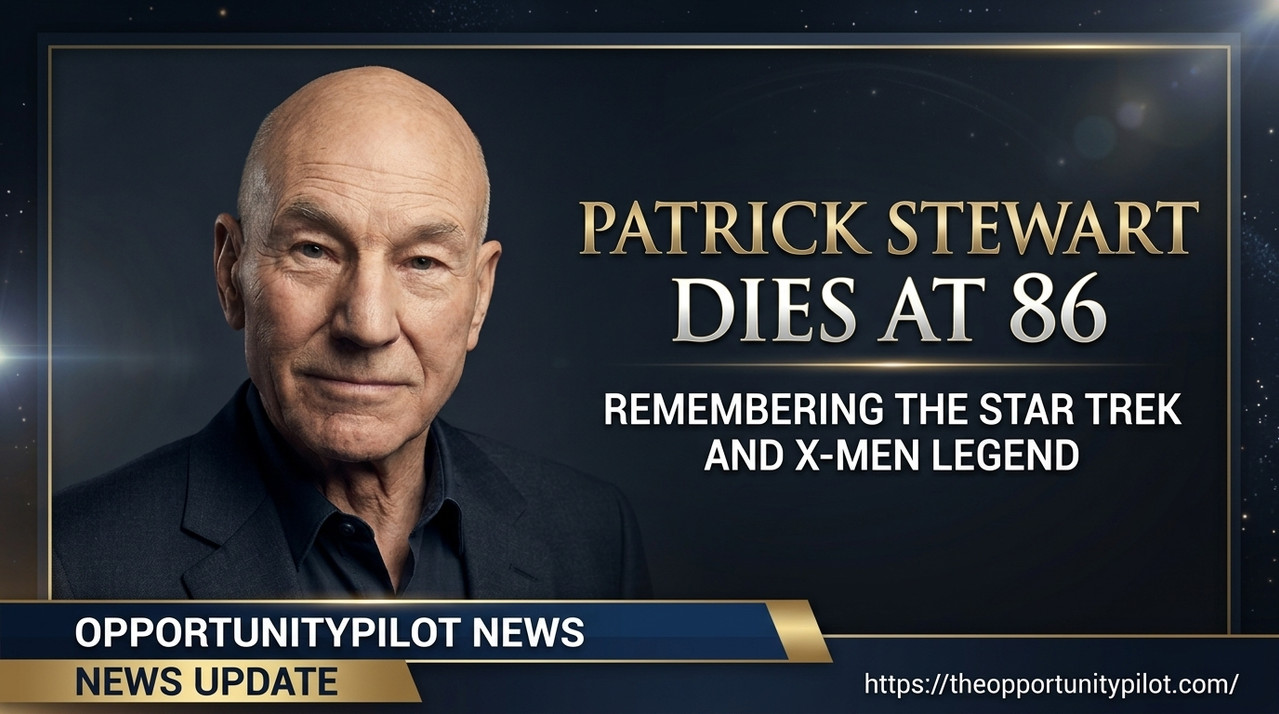
Patrick Stewart Dies at 86: Remembering the Star Trek and X-Men Legend
Sir Patrick Stewart, one of Britain's most respected stage and screen actors, has died at the age of 86.
Stewart died at his home in Los Angeles on Wednesday, 28 October 2026. His death was announced on social media on Thursday, 29 October, in a statement from his family. The statement said he had experienced a period of illness involving Alzheimer's disease and Lewy body dementia.
His death marks the end of a remarkable career spanning more than six decades. He earned acclaim as a Shakespearean actor before becoming an international star through his roles as Captain Jean-Luc Picard in Star Trek: The Next Generation and Professor Charles Xavier in the X-Men film series.
Stewart's performances brought him audiences across generations. For some, he was the calm, thoughtful captain of the Starship Enterprise. For others, he was the wise and powerful mutant leader who believed that people with extraordinary abilities could help build a better world.
Beyond those famous characters, he was a distinguished theatre performer, a familiar face in film and television, and an advocate for human rights and other charitable causes.
A difficult childhood and an unlikely journey to fame
Patrick Stewart was born on 13 July 1940 in Mirfield, West Yorkshire, England. He grew up in a working-class family during a period when opportunities in the performing arts were far from guaranteed.
His early life was difficult. In later accounts of his childhood, Stewart spoke about growing up in a home affected by poverty and domestic violence. His father had served in the British Army during the Second World War, and the effects of that experience shaped family life.
Despite these challenges, Stewart developed an interest in acting while still young. A teacher encouraged him to pursue the craft, helping set him on a path that would eventually lead to professional theatre.
He left school as a teenager and began working in journalism before committing himself to acting. After training, he built his career through stage work, including performances with the Royal Shakespeare Company.
Theatre became the foundation of his reputation. Stewart developed the voice, discipline and understanding of language that would later define many of his most recognisable screen performances.
A Shakespearean actor before international stardom
Long before he became Captain Picard, Stewart was established as a serious stage actor.
His work included major Shakespearean roles and performances in classical and modern theatre. He earned critical recognition for his ability to communicate complex emotions and ideas through language.
He performed in productions of plays such as Macbeth, Hamlet and Antony and Cleopatra. His work eventually reached Broadway as well as stages in Britain.
Stewart's Shakespearean background was particularly important to his later portrayal of Jean-Luc Picard. Rather than playing the science-fiction captain as a conventional action hero, he brought intellectual depth, restraint and a strong sense of moral responsibility to the character.
His theatre career remained an important part of his identity even after Hollywood and television made him internationally famous.
In 2010, he was knighted for his services to drama.
Captain Jean-Luc Picard made him a global star
For millions of viewers, Patrick Stewart will always be remembered as Captain Jean-Luc Picard.
He began playing the character in 1987, when Star Trek: The Next Generation premiered. The series introduced a new crew aboard the Enterprise, exploring the future through stories about science, diplomacy, ethics and humanity.
Picard was different from many traditional action heroes. He often relied on reason, negotiation and careful judgement rather than force. His calm authority and ability to think through difficult situations helped make him one of science fiction's most memorable leaders.
Stewart's performance became a defining part of the series, which ran for seven seasons.
He subsequently appeared in four feature films based on the series:
- Star Trek Generations (1994)
- Star Trek: First Contact (1996)
- Star Trek: Insurrection (1998)
- Star Trek: Nemesis (2002)
More than a decade later, he returned to the role in Star Trek: Picard, which premiered in 2020 and ran for three seasons.
The series gave the character another chapter, allowing audiences to revisit Picard at a later stage of his life.
For many fans, Stewart's portrayal represented the best of science fiction: curiosity about the future, respect for different perspectives and the belief that difficult problems could be approached with intelligence and compassion.
Professor X brought his talent to a new generation
Stewart reached another major audience through his portrayal of Professor Charles Xavier in the X-Men films.
Professor X is a powerful telepath who leads a school for mutants and advocates peaceful coexistence between people with extraordinary abilities and the wider human population.
Stewart played the character with warmth, intelligence and moral complexity. Although Xavier possessed enormous power, he often chose persuasion and understanding over violence.
His performances explored discrimination, fear, identity and the responsibility that comes with power. These themes helped make the character meaningful beyond the superhero genre.
Stewart appeared in multiple X-Men films, including X-Men (2000), X2: X-Men United (2003) and Logan (2017). His on-screen friendship with fellow actor Ian McKellen, who played Magneto, also became a memorable part of the franchise's history.
The two actors shared a long-standing friendship off screen, and their contrasting characters created some of the films' most compelling moments.
For a generation of moviegoers, Stewart's Professor X was as important as Picard.
A career beyond science fiction
Although Star Trek and X-Men brought him widespread recognition, Stewart's career extended far beyond those franchises.
He appeared in David Lynch's film adaptation of Dune in 1984, playing Gurney Halleck, a warrior and weapons instructor.
His screen work also included comedies, dramas, television appearances and voice performances. He demonstrated a willingness to move between genres, balancing serious dramatic roles with lighter and sometimes unexpected projects.
One of his most celebrated later achievements was his return to Shakespearean theatre. He continued performing major stage roles even after becoming an established screen star.
His work earned several award nominations and honours, including Emmy nominations and a Grammy Award for a spoken-word recording of Peter and the Wolf.
Stewart's career demonstrated how a performer trained in classical theatre could move successfully across stage, film, television and voice acting without being limited to one audience.
His final years and the family's announcement
The announcement of Stewart's death said that he had died at home in Los Angeles, surrounded by family and loved ones.
His family disclosed that he had experienced Alzheimer's disease and Lewy body dementia.
Alzheimer's disease is a progressive condition affecting memory, thinking and other cognitive abilities. Lewy body dementia is another progressive neurological condition that can affect cognition, movement, alertness and behaviour.
The statement described the support and affection that surrounded Stewart during his final period.
His wife, singer-songwriter Sunny Ozell, and his family were remembered in tributes following the announcement. Stewart and Ozell married in 2013.
The family also suggested that people who wished to honour his memory consider contributing to Alzheimer's research and support resources rather than sending flowers.
Tributes from the entertainment world
Following the announcement, tributes highlighted Stewart's talent, humanity and influence on generations of actors and audiences.
Marvel Studios paid tribute to his portrayal of Professor X, describing him as a remarkable performer who brought grace, intelligence and humanity to the character.
His colleagues from Star Trek and X-Men also remembered him for his friendship, professional generosity and ability to make complicated characters feel deeply human.
His death prompted reflection on the impact of his performances across the entertainment industry. While many actors become closely associated with a single role, Stewart created two internationally recognised characters in very different fictional worlds.
He helped make Picard a symbol of thoughtful leadership and portrayed Professor X as a figure who continued to believe in peaceful coexistence despite conflict and prejudice.
His influence extended beyond the screen through his theatre work, public appearances, charitable activities and willingness to speak about difficult experiences from his own life.
A life of advocacy and public service
Stewart was involved in several charitable and humanitarian causes throughout his life.
He supported organisations working with survivors of domestic abuse, refugees, veterans and animal welfare causes. His own childhood experiences informed his long-standing concern about domestic violence.
He also served as an ambassador for the International Rescue Committee, which works with people affected by conflict and humanitarian crises.
These activities formed an important part of his life beyond acting.
For many admirers, his legacy therefore includes not only memorable characters but also his public advocacy and willingness to use his visibility to support people facing difficult circumstances.
The legacy of Patrick Stewart
Patrick Stewart's career offers a rare example of sustained success across several generations of entertainment.
He began as a dedicated stage actor, gained international recognition through television and film, and continued to explore demanding roles throughout his life.
As Jean-Luc Picard, he gave audiences a model of leadership based on thought, restraint and diplomacy. As Professor X, he portrayed a character seeking peace in a world shaped by fear and division.
Those performances connected with viewers because they explored questions larger than the stories themselves: how people use power, how societies respond to difference and how individuals make decisions when the stakes are high.
His work also challenged the idea that an actor must choose between classical theatre and popular entertainment. Stewart demonstrated that a performer could bring Shakespearean discipline to science fiction and superhero films without losing the qualities that made both genres distinctive.
He leaves behind a body of work that will continue to introduce him to new audiences, from theatre enthusiasts watching his Shakespearean performances to younger viewers discovering the Enterprise or the X-Men for the first time.
Sir Patrick Stewart died on 28 October 2026, aged 86. His career and performances will remain an important part of British theatre and international screen history.
Sources: The New York Times, Associated Press, The Guardian and ITV News.
Associated Press obituary: https://apnews.com/article/8b38054ff74d4187a32158d78e345ad7
The Guardian report: https://www.theguardian.com/culture/2026/oct/29/patrick-stewart-dead
ITV News: https://www.itv.com/news/2026-10-29/star-trek-actor-sir-patrick-stewart-dies-aged-86