
Airbnb co-founder and CEO Brian Chesky believes the rise of artificial intelligence will put pressure on two groups of workers: managers who only supervise people without contributing directly to the work, and employees who refuse to adapt to new technology. He argues that future leaders must combine people management with hands-on expertise, while workers should develop a willingness to learn and use AI tools.
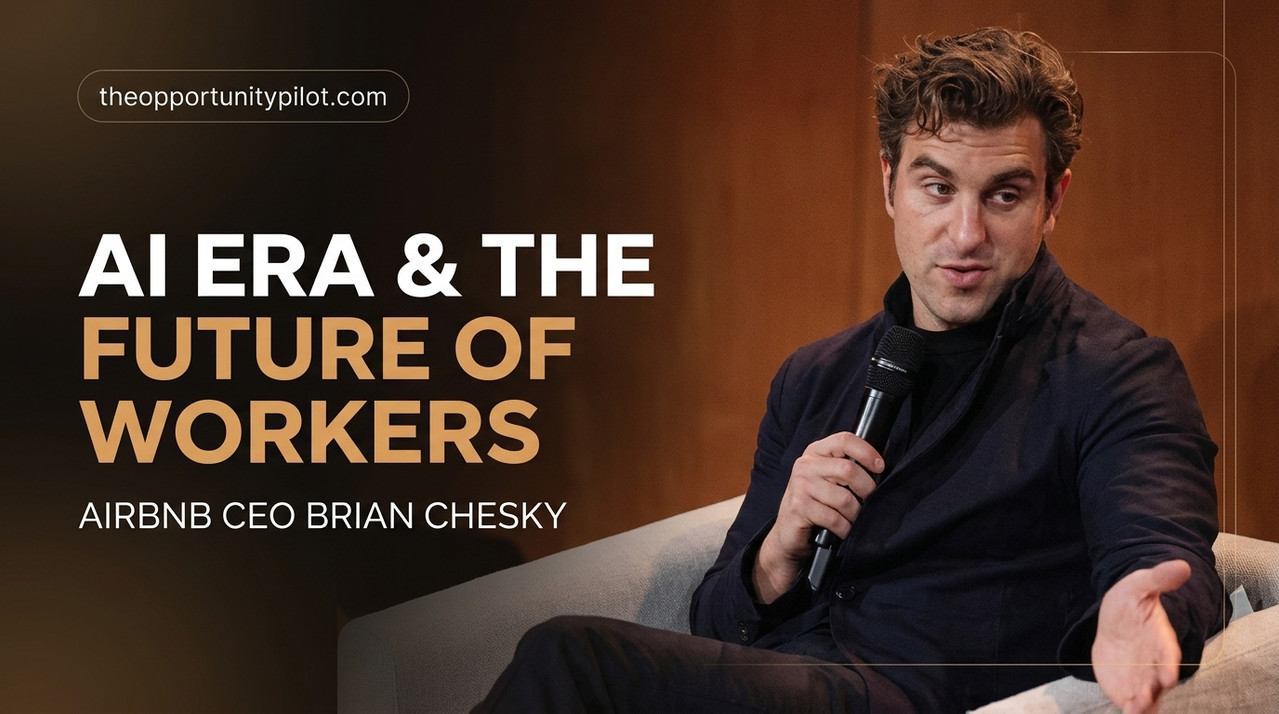
Airbnb CEO Warns That AI Will Change What Employers Expect From Workers
Airbnb CEO Brian Chesky has warned that workers who resist technological change and managers whose responsibilities are limited to supervising others could struggle to remain valuable as artificial intelligence transforms the workplace.
Speaking on the Invest Like the Best podcast, Chesky identified two categories of professionals he believes may struggle to adapt to the AI era: managers who focus exclusively on managing people and workers who are unwilling to change or develop new skills.
According to Chesky, the challenge is not simply whether artificial intelligence can perform certain tasks. It is whether employees and business leaders can change how they work as new tools make it possible to complete tasks differently.
His comments have renewed discussion about the future of management, the value of technical skills and how employees can remain relevant as businesses adopt AI.
The remarks appeared in a Fortune report by Emma Burleigh, originally published on May 7, 2026, and updated on October 25, 2026.
1. Managers May Need to Become More Hands-On
One of Chesky's central arguments concerns managers whose work consists primarily of holding meetings, conducting one-to-one sessions and overseeing employees without directly contributing to the product or service their teams deliver.
He believes this traditional management approach will face growing pressure as AI changes how businesses coordinate work and make decisions.
Rather than focusing only on people management, Chesky advocates for what he describes as a hybrid people manager or manager who is also an individual contributor.
Under this approach, a manager is expected to understand the actual work being performed, maintain relevant technical or professional expertise and contribute directly to solving problems.
For example, a software engineering manager should understand the technology being developed, while a design leader should remain actively involved in design rather than concentrating solely on supervising designers.
Chesky pointed to former Apple chief design officer Jony Ive as an example of a leader who combines professional expertise with leadership responsibilities.
His argument is not that relationships between managers and employees are unimportant. Instead, he believes leaders must connect their management responsibilities to the actual work of their teams.
In an AI-driven workplace, simply coordinating people may no longer be enough to demonstrate a manager's value.
2. Workers Who Resist Change Could Fall Behind
Chesky's second warning is directed at employees who are unwilling to learn new technologies or change how they perform their jobs.
As businesses introduce AI into research, software development, customer service, data analysis, administration and other functions, employees may increasingly be expected to understand how these tools can improve their work.
Chesky has expressed a relatively optimistic view of people's ability to learn AI tools. He believes the tools will become easier to use and that a willingness to learn can help workers adapt.
This means employees do not necessarily need to become AI researchers or professional software developers to benefit from the technology. Depending on their roles, they may be able to use AI to organise information, draft documents, analyse data, automate repetitive tasks or improve the quality of their work.
However, learning a tool is only part of the process. Workers also need to understand when AI is useful, how to check its output and where human judgement remains important.
The practical message from Chesky's comments is that refusing to engage with a changing workplace could leave employees less prepared than colleagues who learn how to use the available tools effectively.
AI Could Reshape the Management Structure
Chesky's remarks reflect a wider discussion across the technology industry about how artificial intelligence could change organisational structures.
Some tasks traditionally handled through layers of management, including routine reporting, information gathering, meeting summaries and progress tracking, can increasingly be supported by software.
As these activities become easier to automate, companies may reconsider how many layers of management they need and what value each leadership role should provide.
Managers could consequently face greater pressure to make decisions, understand technical or commercial details, solve problems and help teams deliver measurable results.
For employees, the change could place greater emphasis on practical skills, adaptability and the ability to work effectively with AI.
These changes will not necessarily happen in the same way across every industry. Organisations have different operational needs, and many management responsibilities involve judgement, coaching, conflict resolution, accountability and strategic decision-making that cannot be reduced to routine administrative tasks.
Chesky's comments therefore represent his view of how leadership should evolve rather than proof that all management jobs will disappear.
What Airbnb's CEO Has Said About AI
Chesky has also spoken about AI as an opportunity for businesses willing to change how they operate.
In a separate interview with CNBC earlier in 2026, he described AI as a major opportunity for Airbnb and argued that companies prepared to transform their operations could benefit from the technology.
His position is that businesses should not wait for competitors to force them to change. Instead, they should consider how AI can improve products, internal processes and customer experiences.
This approach places responsibility on both organisations and individual workers.
Companies need to identify productive ways to incorporate AI into their operations, while employees need opportunities to develop the skills required to use it responsibly and effectively.
The transition may involve more than providing staff with access to AI software. Businesses may also need to reconsider workflows, training, decision-making processes and how performance is measured.
What Workers Can Learn From Chesky's Warning
For professionals concerned about their careers, Chesky's comments offer several practical lessons.
Learn to use AI in your field. Workers should identify the tools that are relevant to their professions and understand how to use them to improve productivity and the quality of their output.
Develop skills beyond routine tasks. Problem-solving, communication, critical thinking, creativity and professional judgement can help employees contribute value beyond activities that software can automate.
Managers should remain connected to the work. Leaders can strengthen their positions by understanding the challenges their teams face, contributing expertise and helping employees produce better results.
Keep learning. The tools available today will continue to evolve. A willingness to learn, experiment responsibly and update professional skills can help workers respond to changing expectations.
Use AI thoughtfully. AI output can contain errors, outdated information or misleading conclusions. Workers should verify important information and protect confidential data when using these tools.
These steps do not guarantee job security, but they can help professionals prepare for changes in how organisations operate.
Will AI Replace Managers and Other Workers?
Chesky's warning has attracted attention because it challenges the idea that seniority or a management title alone will protect a person from the effects of technological change.
However, there is an important distinction between saying that particular work practices may become less valuable and claiming that entire categories of workers will disappear.
AI adoption differs between businesses and industries. Some companies may reduce management layers or automate certain responsibilities, while others may redesign roles and expect employees to combine existing expertise with new technical capabilities.
Human leadership will also continue to involve responsibilities that go beyond task coordination, including building trust, developing people, setting priorities and taking responsibility for decisions.
The more useful question for workers and employers may therefore be how jobs will change, rather than assuming that every role will either survive unchanged or disappear entirely.
For Chesky, the direction is clear: workers need to remain willing to learn, and leaders must demonstrate their value through a deeper understanding of the work they manage.
Final Thoughts
Brian Chesky's comments highlight a growing challenge for professionals in an AI-driven economy. Experience and seniority may remain valuable, but workers and managers may increasingly need to demonstrate that they can adapt, solve problems and contribute directly to results.
For managers, that could mean combining leadership with hands-on expertise. For other employees, it means understanding how AI can support their work instead of avoiding the technology.
AI will not affect every job in the same way, and Chesky's predictions should not be treated as a guarantee that people managers will become obsolete. Nevertheless, his message is relevant to workers preparing for a workplace in which adaptability and continuous learning are increasingly important.
Original sources:
Invest Like the Best podcast, Episode 471 — AI Founder Mode: https://colossus.com/episode/ai-founder-mode/